Software sells on comparisons, not on guides.
A buying committee searches “best X”, “X vs Y” and “what does X cost” long before it searches for an explainer. Rankli sorts every phrase it finds into one of four intents and gives each one its own headline family, its own outline and its own place in the month. The table below is the planner’s real output, not an example we wrote.
Loopline is not real. It is a made-up feedback tool on a reserved .example domain, used because we have no customer whose calendar we could show you instead. The twelve phrases below are ours; every headline, label and section beside them was computed by the same functions that run for a paying project.
Twelve phrases in. Twelve commissioned pieces out, in this order.
Nothing below was typed by a person. The intent is classified from the phrase, the headline is chosen from the pattern family that fits its shape, and the label is derived back out of the headline — which is why a label can never disagree with the piece it sits on.
| Target phrase | Commissioned headline | Intent | Type |
|---|---|---|---|
| customer feedback software pricing | Customer Feedback Software Pricing: What You'll Actually Pay | Transactional | Pricing |
| best customer feedback software | Best Customer Feedback Software: What to Look For in 2026 | Commercial | Buyer's guide |
| how much does feedback software cost | How Much Does Feedback Software Cost — a Plain-English Explainer | Transactional | Explainer |
| customer feedback software for saas | How to Choose Customer Feedback Software for SaaS (What Matters, What Doesn't) | Commercial | Buyer's guide |
| customer feedback software free trial | Customer Feedback Software Free Trial, From Signup to First Result | Transactional | How-to |
| is customer feedback software worth it | Is Customer Feedback Software Worth It? What the Numbers Say | Informational | Verdict |
| customer feedback tools comparison | Customer Feedback Tools Comparison, Without the Marketing Copy | Commercial | Comparison |
| what is a feedback loop | What Is a Feedback Loop? The Answer in Five Minutes | Informational | Explainer |
| product feedback management | Product Feedback Management: How It Works and When It Matters | Informational | Explainer |
| how to run a customer interview | How to Run a Customer Interview: A Field Guide | Informational | Guide |
| benefits of closing the feedback loop | Benefits of Closing the Feedback Loop: What Holds Up in Practice | Informational | Benefits |
| churn survey questions | The Beginner's Guide to Churn Survey Questions | Informational | Guide |
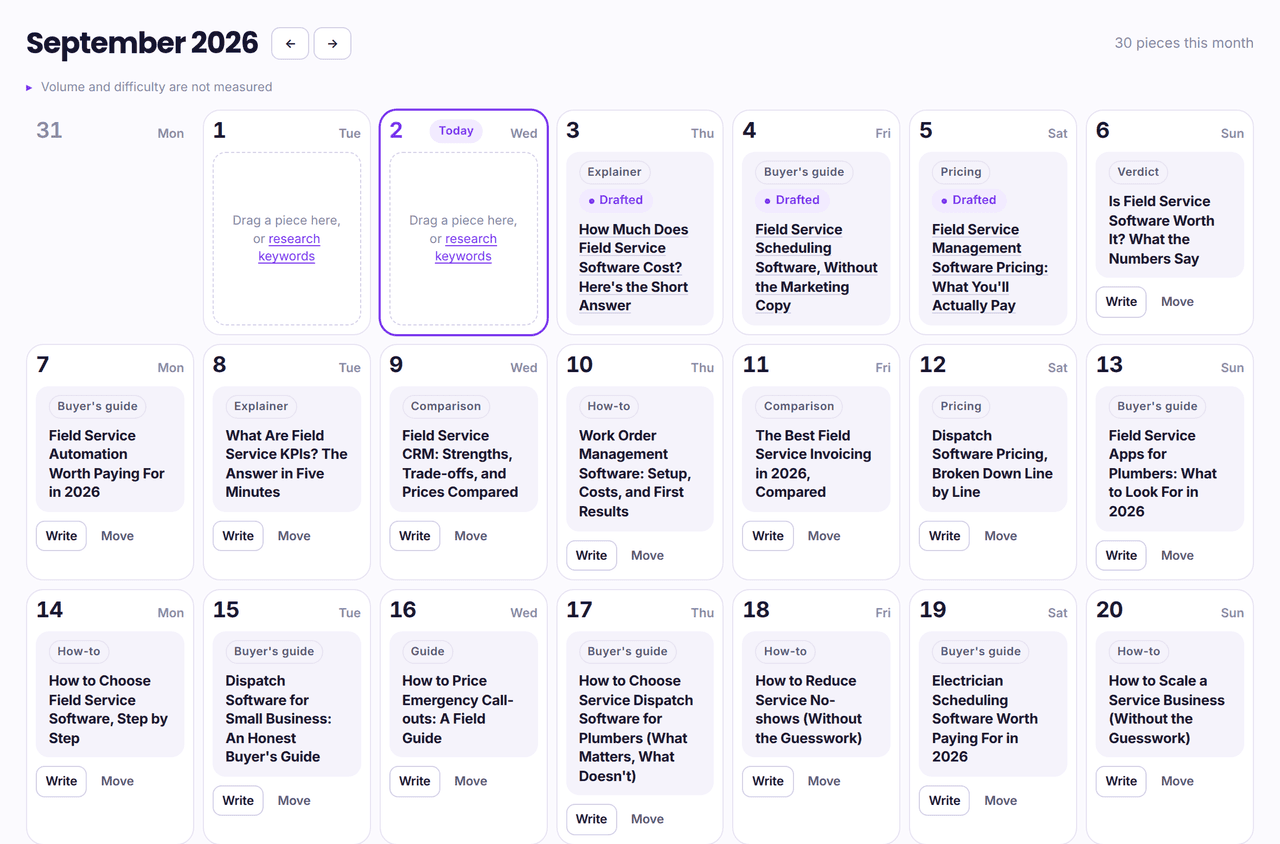
A real month on Growth is 30 of these, drawn from a keyword set an order of magnitude larger and spread across the days you choose. Every piece is editable — retitle it, move it, or drop it — before anything is written.
The month is sequenced, not sorted by score.
Ranking thirty keywords and writing them top-down produces a month that reads like a content farm and cannibalises itself in the first fortnight. Four constraints run over the ranked list instead.
- Money first
- The opening slot prefers a commercial or transactional phrase, because the first piece published is the one with the longest run at indexing before you judge any of this.
- Intents alternate
- Repeating the previous slot’s intent is penalised and a third repeat is close to forbidden. Nobody publishes six comparison posts in a row on purpose; a scorer sorting by value does it every time.
- Cluster-mates stay close
- A phrase from a topic already started in the last few slots is pulled forward, so related pieces land in the same week and can link to each other while both are fresh.
- No two headlines that are the same headline
- Near-duplicate phrases collapse before sequencing and near-duplicate titles are rejected during it — measured on shared words, not on exact matches, so “tools” and “tool” count as one idea.
“Best Customer Feedback Software: What to Look For in 2026”
Product teams at B2B SaaS companies are shortlisting; give them criteria they can defend to their team instead of another wall of star ratings.
- How we evaluatedName the criteria up front so the ranking is checkable, not vibes.
- The criteria that actually matterWhat product teams at B2B SaaS companies should weigh, and the specs that are noise.
- The options, comparedOne honest paragraph each: strongest use case, weakest point, price.
- Where Loopline fits — and where it doesn'tNaming a bad-fit case is what makes the good-fit claim credible.
- Pricing notesReal total cost, including the tiers vendors bury.
- The verdictA recommendation per situation, not one winner for everyone.
Also computed, from the same brief. Note the section that names where Loopline does not fit: it is in the outline for every commercial piece, because a comparison that never concedes anything is one a buyer stops reading — and it is the same discipline our own comparison pages are held to.
Whether the assistants name you when someone asks for a tool like yours.
This matters more to a software company than to almost anyone else: your buyer is already asking an assistant to shortlist your category, and that answer is decided by pages you mostly do not own.
What is measured
- Buying questions in your category, put to 4 engines — ChatGPT, Claude, Gemini and Perplexity — 6 times each, because one run of a stochastic model is an anecdote.
- How often you are named in the answer to each question, and which competitors are named instead.
- Which sources the answers absorbed — ranked by how much of the substance is traceable to them, not by how often a link was listed.
- From Growth up, question clusters are randomised into treated and held-out control arms before the first measurement, so a later readout can subtract whatever the platforms did on their own.
What that cannot tell you
- It is API measurement, not a browser session. No memory, no personalisation, no logged-in history — a systematic, repeatable proxy for what buyers see, not a copy of it.
- Below Growth there are no experiments at all. On Starter you will watch a number move and be unable to attribute it, and the plan says so rather than selling you the chart.
- Even at the top tier the resolution is finite: about 2.1pp on Agency, 4.6pp on Growth. A one-point move is not a result, and we will report it as inconclusive.
What a founder asks before pointing this at their category.
Will it write “us vs a named competitor” pages?
It will plan and write the comparison shapes your keywords contain, including ones naming a rival. What it will not do is invent the rival’s pricing: a check for fabricated statistics, prices and quotes is one of the hard rules, and a draft that trips it is held rather than published. Our own comparison pages carry the date the competitor’s page was read for exactly that reason.
My category is crowded. Can it find phrases worth writing?
Scoring favours the long tail deliberately: three-to-five-word phrases score above one-and-two-word head terms, which are treated as incumbent-owned. Relevance is token overlap with your category, products and audience, so a high-volume phrase that is not about what you sell ranks below a smaller one that is.
Does it know what my product does?
It reads your site and stores what it finds — summary, audience, products, and your voice expressed as instructions rather than adjectives. A piece that stays entirely generic, naming none of that vocabulary anywhere outside its target phrase, trips a hard check and is held. Where the crawl comes back with too little to work from, the product says so rather than inventing a profile.
Can I see the drafts before they go out?
Yes, and each connection defaults to posting as a draft in your CMS. In the workbench the assistant proposes changes as a diff you accept or reject; nothing rewrites two thousand words underneath you.
Do you have SaaS customers with results?
No. None, and no case studies to dress up as some. The substitute we can offer is that this page ran the planner in front of you, our blog is written by the product, and the article checker runs the same scorer the writer runs — on anything you paste into it, free.
Point it at your category and read the plan.
3 finished articles for $1, one measurement round, nothing renewing. The month it proposes for you is the part worth judging, and you will have it on the first day.
Running client sites instead? Rankli for agencies. Selling products rather than seats? Rankli for Shopify stores.